Come join us in our Velogames Tour de Suisse Fantasy Cycling Mini-League! This is your final chance to test yourself before the Tour de France–we hope you’ll join us.
League Name: Pavé
League Code: 08141905

Come join us in our Velogames Tour de Suisse Fantasy Cycling Mini-League! This is your final chance to test yourself before the Tour de France–we hope you’ll join us.
League Name: Pavé
League Code: 08141905
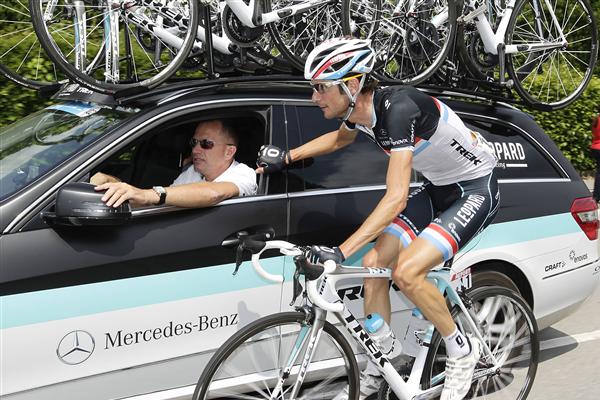
Fotoreporter Sirotti
Aside from the grand tours, the Tour de Suisse is probably the most prestigious national tour a rider can add to his resume. At nine days, it’s also one of the longest. And while some recent editions have tended to favor riders of a different sort, this year’s difficult parcours favors a true all-rounder—someone who can time trial and survive high alpine passes. All in all, the race covers over 1200 kilometers, offers three summit finishes, and has two trials to test many of peloton’s best. For some, this is the final stop before an all-out assault on the Tour de France; for others, it’s the perfect chance to take what many consider to be an impressive victory in it’s own right.
Here are some teams to watch at this year’s race:
Whether he likes or not, Frank Schleck is not Leopard Trek’s most important rider right now. And while some might say the team can take a two-prong approach to the Tour de France, it’s clear that younger brother Andy is the faster, more proven option. That makes a race like the Tour de Suisse all the more important to Frank. The defending champion, Frank will likely be given the green light to try and win the race again for himself, with full knowledge that he’ll be expected to play the role of dutiful lieutenant in France. For some, it’s a sacrifice; to me, it’s an important compromise—one that could reap dividends come July. With Linus Gerdemann, Jakob Fuglsang, and Fabian Cancellara racing as well, the Tour de Suisse could be a banner week for the team.
HTC-HighRoad brings a premier squad to Switzerland, headlined by Mark Cavendish and Matthew Goss making what might just be their final appearance together. Both riders will be hunting for stage wins, supported ably by Bernie Eisel and Bert Grabsch. Michael Albasini—fresh from a stage win in the Bayern Rundfahrt—is another man looking for daily success, albeit from a breakaway. For the GC, Tejay Van Garderen and Peter Velits are the team’s best options. Van Garderen’s third place in last year’s Dauphiné shows the American knows how to handle himself in June, while Velits will be looking to prove his podium place in the Vuelta was no fluke. He might just be the race’s best all-rounder in that he can time trial as well as he climbs.
Another team taking a multi-pronged approach to the Tour de Suisse, Radio Shack hopes that Andreas Kloden and Levi Leipheimer have the legs to contend for the overall victory. Chris Horner was originally slated to participate, but convinced team management that he would be better served by staying at home and training on his own. After his dominant win at May’s Tour of California, can you blame him? For Kloden and Leipheimer, their performances will likely determine the length of the GC leash they will be given by DS Johan Bruyneel at the Tour de France. With Janez Brajkovic on his way to another high finish at the Dauphiné, there’s little margin for error if these two veterans want the support of their squad in France.
Omega Pharma–Lotto comes to Switzerland led by sprinter Andre Greipel. The Swiss tour offers the German a fine chance to prove himself against some of the fastest men in the world. Look for Giro-animator Jan Bakelants to do his best to take a stage or two as well.
Rabobank’s Matti Breschel continues his return to racing at the Tour de Suisse, but his team will likely rely on Oscar Freire for stage wins. In the GC, Robert Gesink is racing the Dauphiné, leaving Bauke Mollema and Giro-revelation Steven Kruijswijk to lead the team here. While Kruijswijk might be at the tail-end of his fitness, Mollema could be poised for a breakout ride of his own.
Next we have Garmin-Cervelo, a team my gut tells me isn’t as harmonious as one might think. Taking a two-tiered approach to the Swiss tour, Garmin brings Heinrich Haussler and Thor Hushovd for stage wins and Ryder Hesjedal, Christian Vande Velde, and Tom Danielson for the GC. For these three North Americans, their Swiss performances will tell us a lot about their prospects for the Tour de France. Will Hesjedal improve upon his stunning ride last year? Will Vande Velde bounce back from his injury-riddled 2010? And will Danielson finally earn a spot on the squad for the French race? As for Thor and Haussler, they’re likely looking to assert themselves ahead of Tyler Farrar in Garmin-Cervelo’s sprint hierarchy.
Last but not least, Quick Step comes to Switzerland with the bulk of Tom Boonen’s lead-out train in tow in an attempt to assess the Belgian’s sprint form. And don’t forget cyclocross star Zdenek Stybar—he’s making an appearance in what will certainly be his most challenging road test to date. Saturday’s Prologue suits him well.
So there you have it—the teams I expect to make the most noise next week. Who are your picks?
Ever seen a spaghetti western? To me, this year’s Tour might as well have been directed by Sergio Leone and played over a soundtrack by Ennio Morricone. Stark landscapes, aging heroes, young upstarts, pistols, you get the idea… Where they had Clint Eastwood, we had Lance Armstrong. Where they had a cast of Spanish-American outlaws, we had Alberto Contador. They had their showdowns, we had Mont Ventoux. And don’t get me started on dialogue!
So whether or not you think the good guy won or lost, here’s Pavé’s look at The Good, The Bad, and The Ugly of the 2009 Tour de France.
(Let this video play in the background as you read–the effect’s much better.)
The Good
1. Alberto Contador’s Win – Whether you were rooting for him or against him, you have to be impressed by Contador’s victory. His prowess on any given terrain was reminiscent of Spain’s other great Tour champion, Miguel Indurain. Alberto has 3 Tours to go before he’ll be on par with Big Mig, but he’s certainly well on his way. One can only hope the rumors beginning to surface and the questions beginning to be asked prove unfounded.
2. Lance Armstrong’s 3rd Place – To me, Armstrong’s 3rd place is a good thing—and I mean that in the sense that it’s better he didn’t win. A win for Lance would have seemed too scripted, too unreal for a sport that’s seen its share of unbelievable events. An 8th victory after about 4 years of retirement would have brought more rumors, more accusations, and more talk of “it’s too good to be trueâ€. 3rd place allows Lance to bask in the glow of terrific comeback and talk of what might have been, while still looking ahead to next year with the hope that he might go a couple steps higher. Today, we all have to at least admit that maybe the guy’s mortal after all. For the sake of Lance’s reputation, “mere mortal” might not be a bad title–for now.
3. The Youth Movement – A look down the Top-10 will reveal a glimpse into the Tour’s future—and it’s a good one. Young guns like Andy Schleck, Vincenzo Nibali, and Roman Kreuziger seem destined for Tour glory one day. This talent combined with the peaking stars like Bradley Wiggins and Frank Schleck will make for some terrific battles over the next few years. Young climbers such as Jurgen Van Den Broeck and Brice Feillu look poised to blossom into riders their respective countries can rally behind in July. And remember folks, that Spanish guy who won? He’s only 26!
4. Mark Cavendish – Man, oh man! Or should I say, “Manxâ€? Cavendish was heads and shoulders—literally, on some occasions—ahead of his competitors. While I still would argue that his team deserves half the credit, we still need to acknowledge the accomplishments of the most electrifying British rider since Chris Boardman rode to victory in the Prologue using Mavic’s electronic ZAP components. Before the Tour, I suspected Columbia might win 10 stages; I wasn’t betting on Cavendish winning 6 all by himself. Think of it, the guy won more than one third of the entire race! The record for wins in a year is 8, perhaps a bit lofty in this day and age. That said, I’ll never doubt Cavendish again. Now, about that mouth…
5. The Race was Clean – Were it not for Danilo Diluca and a handful of other CERA positives from earlier in the year, we might have had a race where we didn’t even think of doping. But I’ll settle for a Tour free of positives, raids, and expulsions. Time might tell a different story, but for now we all should satisfied.
The Bad
1. France’s GC Hopes – As we mentioned earlier, there might be some relief on the horizon, but for now, we have to consider it bad when your country does so poorly that the New York Times takes up space writing about it. Blame it on what you will, but it’s not good when your best GC rider was 10th, and that itself is largely due to a long breakaway on a transition stage. What does France have to do to develop a legitimate contender for the overall win in its national tour? Maybe another Norman conquest would do it? Wiggins and Cavendish would look good riding for the les bleus, non?
2. Blah, blah, blah – I won’t go so far as to call it ugly, but this year’s race sure seemed filled with trash talk: team against team, rider against rider, teammate against teammate, director against rider, etc. Maybe it’s a good thing; were they to just shut-up and ride we might have spent more time wondering if the race was indeed as boring as people say it was. For my money though, I wish people would have spent less time jabbering and more time winning–or at least attacking. Wins make you a legitimate contender/rider/team, not how well you run your mouth.
The Ugly
1. Former Champs/Current Chumps – Cadel Evans, Carlos Sastre, and Denis Menchov should be embarrassed. Cadel Evans has probably just ridden himself out of a contract. Sastre’s just ridden himself into the Vuelta (his third Grand Tour this year). And Denis Menchov’s just ridden his win in the Giro out of everyone’s memory. Evans has proven he’s as mentally weak as we had suspected before the race started. His losses during the first week demoralized rather than motivated him, leaving him as nothing more than road kill as the race hit the mountains. In the end he wasn’t even good enough to lead his own team, or help his replacement for that matter. Time for a shift in focus, Cadel. Classics and week-long stage races are the best you can hope for.
We thought Sastre would give it a go on Ventoux, instead he finished several minutes down, riding into Paris in a lackluster 17th-place overall. Was Lance right about last year’s Tour? And Denis Menchov? He crashed more frequently than Euskaltel in the Tour of Flanders. Seriously, I lost count after week 1. You can’t win if you can’t stay upright. Will both these riders use the Vuelta to end the season on a high note?
3. Big Budget Benelux Buffoons – Silence-Lotto, Quick Step, and Rabobank might have to re-consider accepting an invitation to next year’s race. All together they managed 1 stage win, and it took them 20 stages to get there. In the end it’s hard to say who’s the biggest disappointment as all three teams came to the race with several contenders in many areas. Cadel Evans, Greg Van Avermaet, Tom Boonen, Stijn Devolder, Sylvain Chavanel, Denis Menchov, Robert Gesink, Juan Antonio Flecha, and Oscar Freire represent a vertitable “Who’s Who†of professional cycling over the past 5-10 years. None of them managed a win. Some came close, but not enough to be counted as respectable given their experience, talent, and the level of expectation.
The biggest shame might have to be Tom Boonen, whose team worked so hard to get him on the line in the first place. Now Tom’s going to the Vuelta to salvage his season; anything short of a world title and his Spring exploits could be forgotten. Look for these teams to be the most active as the summer transfer period begins. Maybe this year they can avoid signing riders who will go from being Tour revelations to exposed cheats?
And that brings our feature to a close. Cue the guitar, trumpet, and zamfir.
What about you? What did you find to be the Good, the Bad, and the Ugly of this year’s race?
Share your comments below.
 Here at Pavé we’re getting geared-up for our first year of coverage of this year’s Tour de France. Expect updates and comments on a daily basis, as well as speculation, gentle rants, and whatever else we might have up our sleeves.
Frankly, we’re hoping it will be the best month Pavé yet!
To begin, we thought a team-by-team preview might be in order, particularly since the web is inundated with reports on the individual favorites. We’ll go alphabetically through all 20 teams, posting 5 each day as final rosters are submitted.
Come back daily to see what’s new!
Here’s Part Une:
AG2R-La Mondiale
AG2R won two stages in last year’s Tour (albeit one was due to Riccardo Ricco’s forfeit) and returns this year hoping for more of the same. They take the start in Monaco Saturday with Cyril Dessel as their “GC Riderâ€, but he’ll really just be hoping for another stage win and possibly a finish in the Top-10 (although Top-15 or 20 seems more like it). Vladimir Efimkin would love to win a stage outright, while talented escape artists like Stéphane Goubert, Jose-Luis Arrieta, and Rinaldo Nocentini will look to make things interesting. This is a team that makes it’s budget during July, and anything less than at least one stage will be considered a disappointment.
Agritubel
Agritubel takes the line hoping for stage wins and perhaps a Top-10 from the soon-to-be-retired Christophe Moreau. If Moreau can pull a Top-5 result in the Monaco Prologue his team will be one to watch during the first few days as he would love to pull on the Maillot Jaune once again. However, like many of the French teams, Agritubel’s real pain et beurre comes from the opportunists that stack its roster. The Feillu brothers (especially Roman), Sylvain Calzati, and Nicolas Vogondy are all riders capable of winning after long days in breakaways. Roman Feillu evens has the finishing speed to pull a surprise in a small sprint every now and again.
Astana
By most accounts, this is Astana’s Tour to lose. The team’s Tour roster can count 10 Grand Tour victories between Lance Armstrong and Alberto Contador, and several podium placings and Top Ten finishes through riders like Levi Leipheimer, Yaroslav Popovych, Andreas Kloden, and Haimar Zubledia. That said, one can’t help but wonder if this team has simply too much talent to work together cohesively. On top of that, it’s not like Astana’s had a drama-free Tour build-up either. Besides the circus that surrounds Lance Armstrong, the team has faced a sponsorship crisis, several rumors of Contador’s departure (first to Spain then to the USA), and now a bit of a dust-up over the immensely popular and talented Chris Horner’s omission from the Tour team (most likely to keep Contador content). Clearly this is not the preparation Johan Bruyneel wanted for his team over the past 6 weeks.
When the race begins on Saturday, right away we’ll see a crisis of too many cooks to stir the soup. Look for Armstrong, Contador, and Kloden to ride good prologues, forcing the team to immediately make decisions about who it will protect throughout the first week. Expect at least one rider to begin pouting within the first 4-5 days.
Assuming all goes at planned during the opening days, by the time the race hits the mountains we might witness a full-on rift with lines being clearly drawn between the Armstrong and Contador camps. It could create exciting racing for the fans, but it will be a nightmare for Johan Bruyneel. Will Contador crack under the weight of Lance and his entourage? Will Armstrong’s ego allow him to survive should things not go quite as swimmingly as it used to for him in the Tour?
The key will be Johan Bruyneel. Johan will need to define clear and consistent roles for his riders early. He will need to cultivate trust within the team and hope that his decisions are proven wise in the race’s decisive moments. If he can convince his riders that winning the race for the team is more important than winning the race for any one individual, he stands a chance to go down as one of the sport’s greatest sport directors. Otherwise, he might be forced to learn a lesson that Joe Torre, former manager of the New York Yankees, came to know all too well: having the most talented players doesn’t always mean you’ll have the best team.
BBox Bouyges Telecom
At this time, BBox’s roster is still unconfirmed. We’ll cover them once their roster’s set later in the week.
Caisse d’Epargne
Like BBox and several other teams, Caisse d’Epargne’s roster is still unconfirmed at this time. We’ll come back to them later in the week!
Cervélo TestTeam
Like many of the other Top Favorite’s teams, Cervélo was not immune to some drama in the weeks leading to the Tour, notably due to the omission of Simon Gerrans from the team’s roster. A stage winner in last year’s Tour and this year’s Giro, Gerrans was certainly a rider worth a place on the team, both for his talents in the mountains and his knack for finding just the right breakaway. Bits of speculation surround his absence; it could come to bite them in the derrière.
As for whom they did take, Cervélo seems to be bringing a team more suited to winning stages than defending Sastre’s win last year. The team will work hard to get Thor Hushovd the Green Jersey and perhaps a stage win or two through riders like Andreas Klier and Heinrich Haussler. Haussler’s particularly interesting to watch as an outside favorite for the Green Jersey.
For his title defense, Sastre will be forced to rely mainly on Inigo Cuesta to help him up the bigger hills, as the rest of the team seems more suited to flatter days. (Here’s where the presence of Simon Gerrans would have made perfect sense.) All in all, Sastre is an outside favorite—at best—to win the Tour this year. Look for him to lose time to the bigger, more talented teams and riders, ultimately hoping for a Top-5 placing and a stage win when things get hilly.
Like its compatriots, Cofidis will come to the Tour hoping for a stage win or two and—if he can put his l’argent where his bouche is—the polka dot jersey for David Moncoutié. Moncoutié shouldn’t be discounted; he’s a talented rider and has won a stage in the Tour before. Look for him especially on Stage 13 into Colmar, a transitional mountain stage with two Category 1 climbs—and no radios. As for the rest, breakaways will be the key with riders like Remi Pauriol taking turns off the front hoping for glory. Bingen Fernandez is also a potential pick to win a stage. It seems like Bingen’s been around forever; many in the peloton would appreciate seeing him take the big win he deserves. It could be his last chance.
That’s it for now. Come back soon for the next team previews and more!
Here’s Part Trois in our team-by-team preview of this year’s Tour de France. Tomorrow will be the last 5, including some we missed earlied due to rosters not being finalized.
You can read Part Une here, and Part Deux here.
Don’t forget to add us to your RSS reader, follow us via Blogger, and keep track in 140 characters or less via Twitter.
And of course, keep those comments coming!
Here’s Part Trois:
Lampre-NGC
Lampre comes to the Tour with aspirations similar to Katusha—minus the preceding drama (See Part Deux). For Alessandro Ballan, the goal is a stage win in the rainbow jersey, thus propelling him into the second half of the season with the hope of more wins to come. Simon Spilak is another rider to watch for in a breakaway; he’s talented and aggressive. In the sprints, Lampre will be backing Angelo Furlan, but he’s a step below the A-List field sprinters. Look for him later in the race if he can survive past the mountains.
Marzio Bruseghin comes to the Tour following his Top-10 ride in the Giro ready to test himself in July. A time trialist who can also pull good results in the mountains, Bruseghin has to be counted as at least a dark horse for the Top-10. He doesn’t have much of a team to back him when things get tough, but if he can follow the right moves and play-off the other, deeper squads he could find himself well-placed come Paris.
Liquigas
Don’t let Liquigas fool you. They say they’re coming to the Tour with modest aspirations, but they’re certainly capable of turning the race on it’s ear. Co-Leaders Roman Kreuzinger and Vincenzo Nibali are still considered by mangement to be a year away from a serious assault on the Maillot Jaune, but that could be a smoke screen to protect the youngsters—23 and 24 respectively—from the intense pressure favored status brings. Both can climb and time trial. Kreuzinger won the Tour de Suisse last year before finishing the Tour in 12th place; Nibali finished 7th in this year’s Dauphiné following his 20th place in Paris in 2008. Both riders will be motivated to take the next step to greatness, and—assuming they can avoid an inter-squad feud—can easily finish within the Tour’s Top-10.
Franco Pellizotti will be riding the race fresh from his 3rd place in this year’s Giro. The other two will certainly appreciate his presence. Franco’s a talented climber who can help in the more difficult stages; he’s also used to the pressure of riding for the GC. While guiding the youngsters, he’ll be shooting for a stage win himself. Look for him on transitional mountain stages, or perhaps, Mont Ventoux if he’s down on GC.
For the flatter days, Liquigas will be relying on former stage winner Daniele Bennati to regain the speed he’s displayed in the past. Watch for Aleksandr Kuschynski and Frederic Willems in breakaways—both are classics-type riders capable of winning following a long day off the front.
All in all, Liquigas comes to the Tour with perhaps one of the most well-rounded teams in the race. Capable of winning on multiple fronts, with good direction they could seriously threaten the supremacy of the more heavily-favored Astana’s, Rabobank’s, and Saxo’s.
Team Milram
Milram comes to the Tour with perhaps it’s best team in recent memory. Young, aggressive, and well-rounded, it’s a team of riders capable of animating the race on several fronts.
Fabian Wegman comes to the Tour for the first time in recent memory without the jersey of German National Champion. Wegman’s an attacking rider who perhaps gets a bit too eager at times. Maybe not having the beacon of the all-white German Champ kit will temper his aggression just enough to get him the win he deserves.
Linus Gerdemann and Gerald Ciolek came over from Columbia after last season. Gerdemann will be Milram’s man for the GC and Ciolek their sprinter. Both could pull a surprise here and there—Ciolek more so than Gerdemann. Ciolek’s greatest asset is his endurance; he can last all the way to Paris long after other sprinters have gone home. Gerdemann will have Markus Fothen supporting him in the mountains as he shoots for the Top-10.
Finally, there’s a bevy of talented riders eager for stage wins including Peter Velits, Niki Terpstra, and Christian Knees. All have shown good form over the season so far, and they should be seen frequently off the front. It could be a very good Tour for Milram. It’s about time, isn’t it?
Quick Step
Quick Step’s full team has been confirmed with one major caveat: it has yet to be decided whether or not Tom Boonen will be allowed to compete following his positive test (out of competition) for cocaine. We”ll have to wait for Friday to get the final answer.
With Boonen, Quick Step’s goal is clear: win as many flat stages as possible while working to get Boonen the Green Jersey. Without Boonen, the team will take Allan Davis to the race. Davis is a capable sprinter, but he’s no Tom Boonen (understatement of the year?). He stands far better chances once the race gets closer to Paris and the pure sprinters have gone home.
Stijn Devolder will once again be trying his luck at the GC, but it’s all but been concluded that it’s not his cup of tea. He should probably just do his best for a stage. But Boonen notwithstanding, Quick Step’s best chance for stage success probably lies in the capable hands of Sylvain Chavanel. He was one of the race’s key animators last year, and he’ll certainly be motivated to win another stage in his home tour.
But let’s face it: it all comes down to Boonen for Quick Step. With him, 4-5 stages are possible, without him, maybe 1 or 2.
Rabobank
Denis Menchov and his Rabobank colleagues might be the team everyone fears the most. An accomplished Grand Tour rider, Menchov comes to the Tour straight from his Giro victory, the last race he’s entered. Menchov finished 3rd in last year’s Tour (following Kohl’s expulsion) more or less by following wheels in the mountains and making-up chunks of the time against the clock (Menchov’s one rider who might dispel my claim yesterday that only Cancellara/Garmin/Astana/Columbia will finish in the Top-10 in the Tour’s TT’s). This year the pressure will be on him to play more of an aggressive role; he’ll have to if he wants to win. Alberto Contador and Cadel Evans are much better GC riders than Danilo DiLuca; Menchov’s “me and my shadow†strategy won’t work as well in France as it did in Italy.
Rabobank brings a talented team with Menchov to Monaco. Robert Gesink will get his first stab at riding the Tour. He could prove to be Menchov’s biggest ally in the mountains along with Laurens ten Dam. Stef Clement and Joost Posthuma are two rouleurs capable controlling the flatter stages and adding firepower in the TTT. Juan Antonio Flecha will be seeking stage wins, as well as his compatriot, Oscar Freire. Freire’s always a favorite for the Green Jersey; Clement and Posthuma will help in that regard.
But in the end, it will all come down to Menchov. He’ll need a good mix of aggression and consistency if he hopes to win. If he does, he’ll join an exclusive group of riders who can say they’ve won all three Grand Tours.
That’s it for now. Keep coming back daily for coverage, comments, and more. It will be Pavé’s biggest month since April!
Here’s the fourth and final installment in Pavé’s “Les Équipes du Tour” Preview. If you missed them, you can read Part Une here, Part Deux here, and Part Trois here.
Keep coming back for more coverage, predictions, and reactions to events as they unfold at le Grand Boucle. We promise daily coverage of all that happens.
Tomorrow, we’ll be making 5 Indefensible Claims about this year’s race–be sure to check it out!
Now back to the Preview:
Saxo Bank
It would be a serious mistake not to consider Andy Schleck a top favorite for this year’s Tour de France. Thanks to Carlos Sastre’s departure and his brother Frank’s injury in the Amstel Gold Race, Andy should go into this year’s Tour with the full team at his disposal. Whether he will or not remains a big question as the Tour begins.
Saxo takes the start in Monaco with one of the most well-rounded teams in the race. Lacking only a field sprinter, the team is built for controlling things for whomever it deems its GC leader. Fabian Cancellara, Jens Voigt, Stuart O’Grady, and Kurt-Asle Arvesen are rouleurs who will help Saxo finish near the top of TTT and control things on flatter roads. And speaking of Spartacus, he’s showed tremendous form as of late, winning the Tour de Suisse and the Swiss National Championship–in the road race. Clearly anything but yellow in the Prologue will be a disappointment for Cancellara, and the team will quickly need to decide how long it wishes to defend his maillot jaune. The other three will also have their chances for breakaway stage wins once the GC scene gets a bit more settled; they’ve all had Tour stage success in the past.
The best thing about Saxo’s rouleurs is their ability to set the pace in the mountains. It’s not strange to see riders like Cancellara and Voigt riding men off the back of the GC group when things get steep. And if they can’t, Saxo has talent like Gustav Larsson, Chris Anker Sørensen and Nicki Sørensen to help in the mountains. Anker Sørensen’s riding his first Tour, and is a rider to watch for the future.
The wild card is Frank Schleck. His status needs to be assessed quickly so as not to compromise the team’s chances for GC success. If he’s injured, he should be used as a decoy early, attacking when he can to tire the legs of other teams. If healthy and his brother can play off one another in the Alps to try and crack the competition (and hopefully not each other).
All in all, it should be another banner year for Bjarne Rijs and his team. With a talented roster, stage wins should be plentiful. But for the GC it will all come down to the two men with the same last name—and no, we don’t mean the Sørensen’s.
Silence-Lotto
Cadel Evans comes to the Tour a bit more relaxed this year as at least some of the weight of being “Top Favorite” has passed from him to other riders. For Evans, a rider with a penchant for cracking under pressure, this is a very good thing. At least in the early stages, Cadel and his team should ride free of the burden of controlling race, content to sit back and let others set the pace when things matter most. Evans is not as talented as Contador, Armstrong, and maybe even Andy Schleck; he’ll need to be consistent and look to capitalize on his competitors’ bad moments–if they have them. That said, he can win this race. Some good TT’s and a well-timed attack or two could put him in yellow. Then the pressure’s on to keep it.
More importantly, this year Evans seems to have a team behind him more committed than ever to getting him to Paris on the top step of the podium. Gone are the days of splitting the team between Evans’ GC hopes and Robbie McEwen’s stage and Green Jersey aspirations. Yes, Greg Van Avermaet is there, but he’s a rouleur able to help the team when asked, while still mixing it up for a stage here and there (but not enough to warrant a full complement of riders to form a lead-out train).
Thomas Dekker was planning to take the line hoping to prove the glimpses of talent he’s showed in the past weren’t anomalies. He could have been Evans’ greatest ally when the race hit the mountains. Alas, he’s been left-off the squad (and now fired) following a 2007 positive test for a form of EPO. He’s been replaced by Charly Wegelius, an adequate and less temperamental substitute. Wegelius and Matthew Lloyd will be two of Evans’ most important assistants in the mountains. And let’s not forget Belgian Super Domestiques Johan Vansummeren and Jurgen Van den Broeck, two riders capable of setting searing paces on the flats and ascents respectively.
In the end though, it will all come down to Evans. If he can exploit the other teams’ weaknesses, particularly the potential rivalries within some of those teams (Astana in particular), he can certainly take home his first win. And if he does, he will have accomplished it when all the greatest riders of his generation were present. That’s quite an achievement.
Skil-Shimano
In many ways, Skil-Shimano is like a French team. The Dutch Wild Card team comes to its first Tour with a diverse roster of men hoping to gain exposure and stage wins. Frenchmen Jonathan Hivert and Cyril Lemoine will try for victory on their home turf, while Fumiyuki Beppu seeks to become the first rider from Japan to win a Tour stage. That said, the team’s biggest chance for success comes from Kenny Van Hummel. Van Hummel won the Four Days of Dunkirk this year and finished 2nd in last week’s Dutch Championship. It won’t be a surprise if he leaves France with a stage or two and possibly a fat new contract to ride for a Pro Tour team in 2010.
BBox Bouygues Telecom
We would have previewed BBox’s Tour team on Monday, but its roster wasn’t finalized at the time. Like many of its compatriots, BBox comes to the Tour seeking stage glory. Thomas Voeckler still remembers the year he took yellow in the first week and fought savagely to keep the jersey longer than anyone expected. He’s always capable of a similar exploit.
Pierrick Fedrigo won this year’s Dauphiné stage into Briançon. He’s a rider capable of winning from a mountain breakaway, and could be one to watch on Ventoux if a break is given some latitude by the rest of the GC contenders. Laurent Lefèvre and Yuri Trofimov are riders with similar tendencies, while the youthful Pierre Roland has been tipped as the next French climbing sensation. Finally, it should be noted that BBox is one of 2 teams with a Japanese rider as Yukiya Arashiro joins Skil-Shimano’s Fumiyuki Beppu in his attempt to become the first Tour stage winner from Japan.
Caisse d’Epargne
Like BBox, Caisse d’Epargne’s roster wasn’t finished when we went to post, so we’re covering them now.
Caisse d’Epargne comes to the Tour for the first time in recent memory without Alejandro Valverde. That’s not necessarily a bad thing. Not to be harsh, but Valverde has failed to show an ability to succeed in the pressure-cooker of the Tour. He’s much more suited to the hillier classics, shorter stage races, and the Vuelta.
Without him, Caisse d’Epargne will rely on Luis León Sanchez for its GC aspirations; the team might be very pleasantly surprised. León Sanchez has been winning major races for a while now and has only been prevented from full-blown stardom by having to ride for Valverde. Now he has the team fully at his own disposal and could make them forget about Valverde’s absence. He can climb, he can time trial, and he possesses a killer instinct that could see him put a bit of fear in the eyes of the bigger favorites. A Top-10 is a distinct possibility; a Top-5 woul be a surprise to some, but not for us.
León Sanchez has a talented roster of riders behind him including David Arroyo and Ivan Gutiérrez. More importantly, he has the experienced Oscar Pereiro to guide him through the tricky business of leading a team in the biggest race in the world. Overall, it could be a pleasantly surprising July for Caisse d’Epargne—unless your initials are “AVâ€.
That’s it for the first annual Pavé Team-by-Team preview of this year’s Tour contenders.
Who did we miss? Where did we over- or under-hype?
Share your comments with the rest of us–and come back tomorrow for more!