Behind the Barriers Season 2 Premiere!

We’re really excited here at Pavé for Season 2 of Behind the Barriers. First episode just came out today, covering Interbike + CrossVegas – enjoy!

Posted in Featured, Races | Leave a comment

The Race Before the Race – Understanding CX and UCI Points

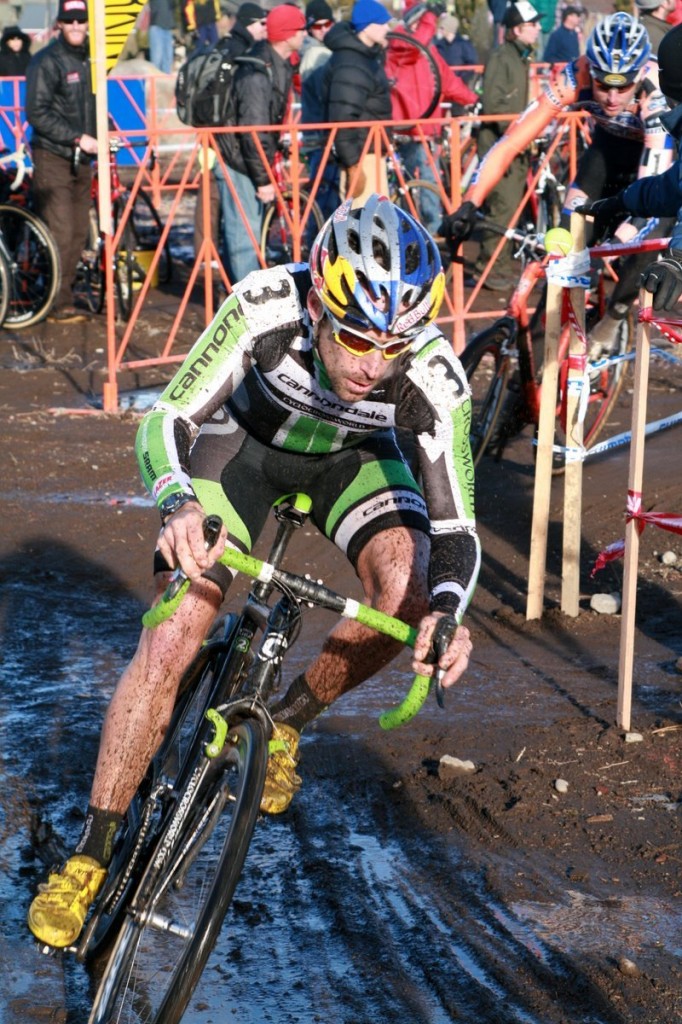
2010 CX Nationals - Tim Johnson

Photo by Dave Roth, http://www.dmroth.com/

The most critical part of any cyclocross race is the start.

Being first out of the gate and to the first technical section provides an advantage as things often bunch-up behind the first group. Without a good start, a rider can go from contending for the win to being ten to twenty seconds behind – in a matter of moments. With the start being so important, the obvious question is how does one get to start on the front row? The answer is actually rather simple: UCI points determine who starts where. Placing at a UCI-sanctioned race earns a rider UCI points, which determine their start position for the next race. The more UCI points a rider has, the closer to the front they start.

However, not all races offer the same amount of UCI points. Races are categorized by prestige, history, and prize money: Category 2 (C2), Category 1 (C1), World Cup (WC), National Championship, Continental Championship, or World Championship.  Thus, the better a rider does at higher category races, the more UCI points he or she receives.

Here’s a breakdown of the point structure for each category:

Place            World Cup            C1                          C2
1                    200                         80                          40
2                    160                         60                          30
3                    140                         40                          20
4                    120                         30                          15
5                    110                          25                           10
6                    100                         20                           8
7                    90                           17                            6
8                    80                           15                            4
9                    70                           12                            2
10                  60                           10                            1
11                   58                           8
12                   56                        6
13                   54                        4
14                   52                        2
15                   50*                      1

* Points decrease by 2 through 20th place, then by 1 from 25th to 50th-place.  Each rider beyond 50th gets 5 points.

Most races are Category 2 races for a variety of reasons, the most important of which is cost. In order to hold a UCI-sanctioned cyclocross race, a promoter must secure and provide a significant amount of money up front, just to get on the UCI calendar. Also, all UCI-sanctioned races require a minimum prizes to 25 places, include minimum payout amounts. For example, it takes about $800-$1,000 for C2 race to be placed on the UCI’s calendar. The minimum prize payout for a C2 race is $2,232—for a C1 race the figure doubles.

Due to tight sponsorship dollars and a lack of major media exposure, it’s easy to see why in the United States, most UCI cyclocross races are C2 events. In Europe, there are significantly more C1 races because they have the ability to attract large TV contracts and charge admission to the fans. Also, an interesting rule states there can be no C1 races on the same day as World Cup races—thus knocking nearly half a dozen potential C1 dates off the US calendar. Luckily, one can organize a C2 race on the same day as a World Cup race so long as it’s not in the same country.

Restrictions

Beyond a limited amount of categorized races, there are also restrictions on the amount of points a rider can earn via results in a certain category. While a rider may earn copious UCI points at races,  a rider’s UCI ranking and start position is based on a calculated point total that limits the number of C1 and C2 points a rider can use for his or her start position [This has been revised from an earlier version – see comments. -editor].  Only the best six C1 and best five C2 race results count toward a rider’s start point totals. World Cup races have no cap. On one hand, this keeps things fair by giving riders a chance to see the front of the start grid by the end of the season; on the other hand, it severely limits the options better riders have to acquire UCI points, especially in nations with calendars filled primarily with C2 events (like the USA). Thus, in 2010,  Tim Johnson quickly  maxed-out the amount of points he could earn from C2 races, and had to rely on performing in C1 (or World Cup) races in order to improve his start position.

For example

The ins and outs are a lot to digest, but in order to make this a bit easier to understand, let’s take a look at two Americans – one of whom who travelled to Europe last year to compete in the first round of the World Cup in Aigle, Switzerland (Tim Johnson),  and one who did not (Ryan Trebon).

Tim Johnson’s UCI-point total going into that race was 336. However, he’d won five C2 races already, meaning his starting total is actually less since he maxed-out his C2 points. So his point total for the purposes of a start position was 266. Johnson picked-up 26th-place in Aigle, netting 34 points—more points than the second-place rider in the C2 races at Granogue, Delaware. Plus, since there’s no cap on World Cup points, Johnson can use those points for the rest of the season. So for the USGP race the following weekend in Kentucky, Johnson hads 300 points going toward his place on the starting grid.

On the other hand, Ryan Trebon elected to stay home that weekend. Despite  struggling to find wins last season, Trebon still had amassed 227 UCI points. However, he’d already finished six C2 races, so we need to drop his worst result (2 points), bringing his starting total down to 225. If he were to have raced another C2 race, he could have dropped his two worst C2 results (a third and a fourth) to gain a net of 45 points, sending him into that weekend with 272 points toward his starting position.  By electing not to race, his point total stayed at 225, leaving him 75-points behind Johnson. As a result, Johnson would always get called to the starting grid ahead him.

By now it should be clear why Team Cyclocrossworld.com went to Europe  for the World Cup race in Aigle in 2010. With Johnson, Powers, and teammate Jamey Driscoll all finishing the first World Cup race, they drastically increased their overall and starting grid UCI points—all but guaranteeing their places on the first row at the start of every US race. 

It helped shape their dominant season.


Posted in Featured | Tagged , | 2 Comments

Monday Musette: The World Championships

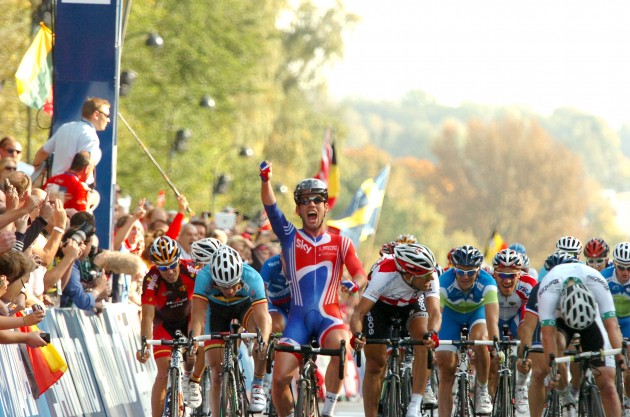
Fotoreporter Sirotti

For today’s Monday Musette, we’ve got the World Championships on our mind. Here’s what we’re chewing on:

  • So, Mark Cavendish is now the road racing World Champion. Those who love to hate Cavendish might have a sour taste in their mouths, but as Fabian Cancellara pointed out in a post-race interview, it was a sprinter’s course, and the fastest sprinter in the world won the race. That is appropriate in its own way. 
  • Credit Cav with being committed to winning this race, despite his Vuelta disappointment and any pre-race vaccilation or avoiding his usual bombast. Clad in a skinsuit and with some sort of prophylactic-looking helmet cover, he was geared up to make himself as fast and as slippery as possible. 
  • The course had a bit of elevation and a bit of technical intrigue – not the least of which was the uphill drag to the finish line that led to a number of slow-motion sprints over the past week – but even after 270 kilometers, its bumps and turns weren’t enough to cause damage and a group of 82 rode to the finish together. A crash half-way through had split the field, leaving riders including Thor Hushovd and Tony Martin stuck behind, but other than that, there was little meaningful attrition.
  • It seemed as though much of the peloton had let the course determine the race long before the race was finished. Thomas Voeckler, Niki Sorenson, and Klaas Lodewijk’s late attack was joined by Johnny Hoogerland, but there was much looking around in between pull-taking.
  •  Though Mark Cavendish was gracious in thanking his Great Britain teammates, including Bradley Wiggins and David Millar (both of whom did the lion’s share in the final laps), it’s worth noting that the late members of his looked to be a bit more multi-national. There’s some clucking on Twitter that Cav’s late lead-out train was comprised of members of Team Sky, thus circumventing the national affair of the World Championships, and tipping Cav’s home for the 2012 season. We’re unconvinced, but unsure. 
  • Matthew Goss deserves kudos for a fine sprint, but from an overhead replay it looks like his patience in launching the sprint was at the expense of an opportunity to box Cavendish in. Behind those two, Andre Greipel beat Fabian Cancellara photo finish for 3rd place. Cancellara, it’s worth noting, was sprinting from the hoods. Far be it from me to teach Sparticus how to ride a bike, but were he in his drops, he could be disappointed with a bronz medal right now.
  • Think there’ll be another crisis of Italian team  management after this year’s WC?

That’s what we noticed yesterday morning. What did you notice? Share your thoughts below.

Posted in Featured, Races | Tagged , , , , , | 3 Comments

The Sticky Bidon – September 23, 2011

Interesting cycling items from across the Internet, September 23, 2011

Seen any cool links we missed? Share ’em in the comments below!

Posted in Sticky Bidon | Tagged , | Leave a comment

Cyclocross Weekend Preview 9/23

Jeremy Powers Wins Gateway Cross - courtesy of Gateway Cross

This weekend sees the North American cyclocross circuit begin to burst forth in earnest, while overseas, a bevy of C2 races means that the Europeans are still in preseason mode until the first major race of the season – a Superprestige race on October 9th.

In North America, the U.S. Gran Prix of Cyclocross kicks off with two races in Sun Prairie, Wisconsin. The USGP is North America’s most prestigious series, and Jeremy Powers’ victory (won in the final race over his then-teammate Tim Johnson) is more a more impressive feather in his cap than a National Championship would have been. This year’s USGP winner will need to be consistently strong, with the strength and endurance to perform well over months of racing with two races on each racing weekend. This weekend, it’s hard to really imagine anybody being able to beat Jeremy Powers, who’s gotten his season off to a very strong start. However, with Tim Johnson having taken a little while off from racing to recover from a cold and, presumably, start to bring his form around, it will be interesting to see if their renewed rivalry can offer Ryan Trebon an opportunity to get away from the due that confounded him all last season.

In Europe, there are C2 races in the Czech Republic, Netherlands, and Belgium. The race in Stribo, in the Czech Republic, will see Zdenek Stybar’s season debut – in his hometown no less. A convincing win from him is probable. Meanwhile, look for the Dutch and Belgian talent to duke it out in Harderwijk and Neerpelt. The season is in its infancy, which can offer an interesting race dynamic. Some of the bigger names with firmly-identified goals later in the season will want to start off measured and paced so as not to fall victim to the January slump that can wreak havoc on a National Championship or World Championship aim. Meanwhile, the talent a level below the top will be racing hard to pick up some early season wins and valuable UCI points. If the hunt for points is confusing to you, fear not – we’ll publish a guide to the ins and outs (as well as overall importance) of chasing UCI points shortly.

Posted in Featured | Tagged , , , | Leave a comment

World Champ By Numbers 2011

Picking favorites for a one day race like the World Championships is tricky. A cyclist who performs well in late August/early September may be totally out of shape come October. Riding on to the podium of a race like the Vuelta will leave you in peak condition, but what sort of impact will three weeks of stage racing have on fatigue levels?

However, we looked at past performances as an indication of what it takes to win and came up with some criteria for winning the World Championships. Last year, “The Numbers” (with a bit of massaging) predicted that Thor Hushovd would win. This year is a little harder to predict, with the Vuelta ending a little earlier, World’s being held over a week earlier, and a number of the favorites thrown off due to injuries in the Vuelta. With a course that everyone is saying favors the sprinters, it’s tough to use basic statistics and expect them to mean anything – but we’ll try nevertheless.

Last year’s 4 criteria were: riding the Vuelta, winning a stage, dropping out before the end of the Vuelta, and having a large (read: non-minimal) team. Let’s see what that means this year. To review the markers:

10/10 World Champions rode the Vuelta

In 1995, the Vuelta was moved to September, and the Worlds were moved to October. This made the Vuelta the perfect race to build form for a late September/October campaign. Before 1995, the Worlds were in August, making it a well-timed race for Tour de France riders, and a target for greats like Eddy Merckx, Bernard Hinault and Greg Lemond. These days, it seems like the one-day specialists have a lock on the race.

Every one of the last 10 champions has ridden the Vuelta as preparation – and only 3 since 1995 (Romans Vainsteins 2000, Óscar Freire 1999, Johan Museeuw 1996) haven’t ridden the Vuelta.

7/10 World Champions won stages at the Vuelta

There’s no hiding form. 7 out of 10 World champs won at least 1 stage at the Vuelta. Some won more. If you loosen those requirements a little, 8 out of the 9 Vuelta-riding WC’s finished in the top three in one or more stages.

Mario Cipollini won 3 stages in the Vuelta before winning the Worlds in 2002. Paoli Bettini took a Vuelta stage before each of his wins (2006, 2007), and Alessando Ballan took one before his (2008). Freire won a stage in 2004, and podiumed in 2001. Last year’s winner Thor Hushovd won stage 6 of the 2010 edition, as well as a 2nd in stage 13.

Others were a little more subtle; Cadel Evans took a few 3rd places en route to winning the overall 3rd place in the Vuelta (2009), and Tom Boonen came in third just once.

Only Igor Astarloa (2003) failed to win or podium on a stage.

9/10 World Champion’s DNF’d the Vuelta

And while there’s no hiding it, form is fickle. Peak too early, and you’ll either lose form or overtrain by the time you reach the Worlds. Back off on training at the wrong time, and you’ll head to the worlds with less than perfect form.

Only Cadel Evans rode the Vuelta to completion, ultimately finishing on the bottom step of the podium. Every other World Champion Vuelta rider dropped out at some point. Some dropped out earlier than others, but the last few champions have dropped out somewhere between stages 13 and 17, in order to avoid complete fatigue brought on by the killer hills of the Vuelta.

Dropping out early seems to be part of the Italian Worlds playbook. Cipollini, Bettini and Ballan all dropped out of the Vuelta – Cipollini did so after stage 7, making his 3 wins even more impressive. Bettini dropped out before stage 18 for both his wins, and Ballan bailed after stage 15. Freire 2001 was a stage 15 dropout, Freire 2004 bailed during stage 12, Tom Boonen hung in through stage 13, and Astarloa called it quits during stage 11.

Last year, Hushovd hung up his bike after stage 16.

9/10 World Champion’s had full (or close) teams

The rainbow jersey isn’t won without help. Full squads supported 9 out of 10 world champions. Team sizes have changed over the years, settling on a maximum 9 in 2005. The extremes have been mitigated – in 2000, Romans Vainsteins won on a team of 3, while many of his competitors were on teams of 12.

Some teammates were unequivocally devoted to delivering their compatriot a win, as was the case with the Squadra Azzurra victories of Cipollini and Bettini. Others didn’t necessarily have total support going in to the race.

Last year’s Thor Hushovd only had a pair of teammates. This is probably an example of where having extensive experience and awareness in the peloton can pay off – if you don’t have your own wheels to follow, knowing the right ones to latch on to is the next best thing.

Where’s that leave us for 2011?

Two riders participating in this year’s World Championships meet all of the above criteria: Tony Martin and Marcel Kittel. Each won a stage in the Vuelta, and dropped out prior to its completion.

Martin clearly used the form he built to his advantage, soundly beating everyone in this year’s Time Trial World Championships, coming in well over a minute sooner than second place Bradley Wiggins’ time. It’s safe to assume he’ll be riding support for the German team, as he’s both likely to be fatigued, and unlikely to be a major threat in a course of this style. That said, it’d be foolish to let him get off his leash in the final laps of the race circuit, given how fast he can ride solo.

Kittel’s win came in a crash marred stage 7, leaving him contending the final sprint against a reduced, but still highly talented group, including Peter Sagan, Oscar Freire and Danielle Bennati. Furthermore, he just won over the likes of Andrei Greipel and Robbie McEwen in the Kampioenschap van Vlaanderen, to bring his win tally in his first full year of professional racing to 14. He’s young, but he’s riding with an experienced German team that should be well prepared to contend in what’s predicted to be a sprint finish. The only major question is, will he be the protected rider on the team, or will it be Andrei Greipel? And if its Greipel, will he still have the opportunity to mix it up in the final sprint, if it comes to it?

Who else?

4 riders won Vuelta stages, and will be riding in “big” teams: Chris Froome for the UK, Pablo Lastras for Spain, and Francesco Gavazzi and Daniele Bennati for Italy. Of the 4, Bennati is the one most obviously suited to the course.

Notably absent from the above is Peter Sagan. Sagan notched 3 wins (and an additional 2 podiums) in the Vuelta, and a total of 14 for the year. He’s well suited to the course, and is currently ranked as a top favorite by both the cycling press and those with the most to lose – the bookmakers. 

Predictions?

This year is hard to apply stats to than last year. 2010 lacked the USA Pro Cycling Challenge as possible tuning race in the month of August – an option some top conteders took this year. It also had a World’s race taking place 9 days later – but a Vuelta that finished 8 days earlier. Similar recovery time should negate any concerns about fatigue differences, but makes it hard to understand the impact races between the end of the Vuelta and the World’s road race has. Is riding the Tour of Britain this year a good idea? Last year you would have had 3 weeks to recover from it prior to World’s. This year, just 1 week. For riders like Mark Cavendish, a major favorite for this year who dropped out of the Vuelta early, it was an opportunity to get some more racing miles in his legs as a lead-in – a necessary gambit, to be sure, but a major unknown when compared with prior year’s successful preparations.

Personally, I’m liking riders like Sagan, Bennati and Kittel for this year’s course. Kittel and Sagan are both exceedingly young – brash and capable of stunning their competitors, but also liable to make mistakes. And while the “numbers” don’t support it, discounting contenders like Mark Cavendish, Philippe Gilbert (never bet against Gilbert), Thor Hushovd, Oscar Freire, Fabian Cancellara – the list goes on and on – would be foolish at best. If riders like Gilbert decide to turn the race into a long-range slugfest, will the sprinters be able to get it together for a bunch sprint?

Think the numbers will mean anything this year? Let us know in a comment below!

Posted in Featured, Races | 4 Comments