Did Phillipe Gilbert Squander the Green Jersey?

Pavé would like to thank Handspun, Clément, and Laekhouse for supporting our coverage of the 2011 Tour de France

Fotoreporter Sirotti

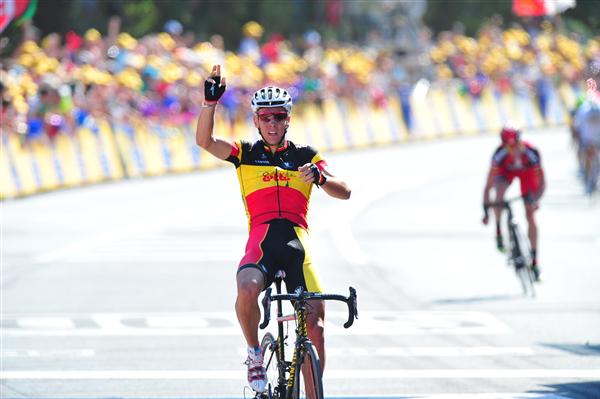
You can be forgiven for having a bit of Tour de France-related short term memory. When the Tour blasted through the Pyrenees and lit fireworks throughout the Alps, it sent the first week back into distant memory. However, before Thomas Voeckler’s tear-fueled defense of the yellow jersey, before Thor Hushovd’s reign of terror, and before Evans, Contador, and the Schlecks really began trading blows in the high mountains, it was Phillipe Gilbert who helped define the Tour de France.

Gilbert had a banner Tour de France. He won stage one and wore the Yellow Jersey for a stage, the Poka Dot jersey for two, and the Green Jersey for a remarkable seven stages. Throughout, he raced with flair and panache, winning difficult uphill sprints and even going on an inspiring late attack on Stage 10. He put up a fight for the Points Competition for longer than anybody really expected of him, and indeed, if it weren’t for Mark Cavendish’s near-stranglehold on conventional field sprints, it wouldn’t have been strange to pick Gilbert for the Points Comp victory. In line with speculation about where he might develop as a rider (will he win all monuments? Will he lose weight and become a GC contender?), his ability to hang tough at the front of the Tour into the early mountains was impressive.

Did Gilbert lose out on an opportunity to keep the lead in the points competition? Let’s take a look at what caused him to miss out on points:

Working for Andre Greipel: Omega Pharma Lotto has found significant Tour success this year, with Andre Greipel winning Stage 10 and Jelle Vanendert winning Stage 14. This must be a morale booster to the team, considering the early injury to GC candidate Jurgen Van den Broeck. However, Gilbert’s commitment to Greipel’s success – whose Stage 10 victory was a long-overdue return on OPL’s investment in the German sprinter – cost him the ability to pick up a handful of sprint points here and there to stay in contention with HTC’s Mark Cavendish and JJ Rojas of Movistar.

A few doomed attacks, including a late dig on Stage 10, ultimately won by Greipel. Gilbert’s attack drew out Thomas Voeckler, Tony Martin, and Tony Gallopin. Though powerful and beautiful, may have been foolish – it left Gilbert unable to contest the finish and he missed out on a handful of Points he may have gotten for a top-fifteen sprint finish. Was even the chance of a solo win on the stage worth the price he paid?

Despite the Omega Pharma-Lotto’s success, Gilbert rode into Paris having been defeated in the Green Jersey competition. Is this an opportunity for a great win lost? Or, is it the reasonable side-effect of a smarter play for more diverse success by Omega Pharma-Lotto?

Furthermore, what are the chances that an attacker or puncheur can win a Green Jersey competition in the Tour de France, or a points competition in any Grand Tour? There’s a growing trend for Grand Tour organizers to build Grand Tours that are geared toward exciting and dramatic racing. Should we see another Grand Tour in the near future with a parcours featuring few conventional bunch sprints and more powerclimbs and opportunities for late attackers, we may see a puncheur winning a Points Competition.

Posted in Featured, Races | Tagged , , , , | 4 Comments

What Made This Year’s Tour de France Exciting?

Pavé would like to thank Handspun, Clément, and Laekhouse for supporting our coverage of the 2011 Tour de France.

Fotoreporter Sirotti

Wow, what an amazing Tour de France this one was! From where we sat, it was one of the most engaging Tours we’ve seen in a long time. What made it a particularly memorable one? We share some of our impressions below.

1. Unpredictability

We raise our thumbs for this Tour’s unpredictability –  coming in, we shared the view of many that the GC fight would be a two-man battle between Alberto Contador and Andy Schleck, much like how it was last year. We even ruminated on who, among what we thought was the field of lesser contenders, would complete the podium. And boy, were we surprised.

In the other leaders’ jerseys, the fights also carried a lot of volatility. Cavendish’s 20-point penalty on Stage 18 made the battle for Green significantly less predictable. Stage 19 promised a short and furiously fast stage, and we wish that we had had access to more coverage of the autobus fight, as we’re sure JJ Rojas of Movistar fought valiantly to make the time cut he knew Cav would miss. In the polka-dot fight, Jelle Vanendert’s performance in the second week put other pretenders on the defensive, and they rose to the challenge. Sammy Sanchez is truly a deserving winner in the finale with his show of strength on Luz Ardiden. And not to forget the White jersey battle between Europcar, Cofidis, and Sky, working hard for Pierre Rolland, Rein Taaramae, and Rigoberto Uran in the closing days of the Tour.

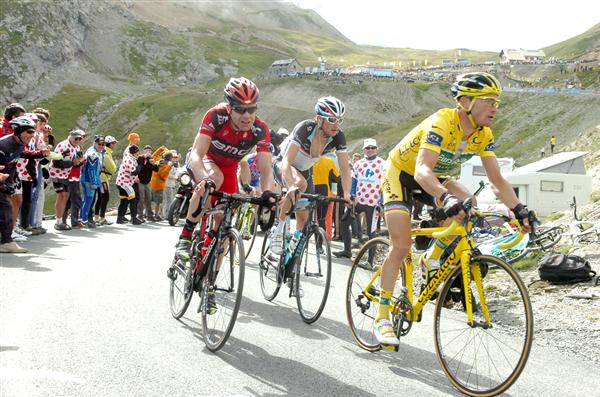
In the intermediate, we were impressed by Hushovd and Voeckler defending the Maillot Jaune despite everyone expecting them to lose it at any moment. They both rode above themselves in order to keep the honor for another day – Hushovd clinging with the leaders on power climbs, and Voeckler refusing to be shaken off in the mountains until it became clear that his ride was going to keep him high on the final GC. Furthermore, after Hushovd lost the jersey, he continued his impressive performance with a stage win from a long solo breakaway in a very charismatic fashion – truly honoring his World Champion’s stripes.

2. Positive racing

Speaking of the GC unpredictability, Contador’s surprising time losses – and his resurgence – changed the calculus of the GC contenders completely. Last year, the tour became a 2-way race early, with Frank Schleck and Cadel Evans exiting early due to crashes and injuries. In this edition, the top contenders managed their risk by making opportunities and forcing others to fight – indeed, that we saw a rider like Tommy Voeckler go from being an “escape specialist” to actually being a top contender highlights this.  Cadel Evans also did the unthinkable: he attacked many times and managed to drop one Schleck or the other or both, and Alberto Contador.

It’s hard to mention positive racing without giving the Tour’s first week a hearty nod. Stages with exciting power-climb finishes offered an opportunity for classics stars like Phillipe Gilbert to shine, as well as an opportunity for a GC contenders to race hard early in the race without too much fear of exhaustion; they also offered more drawn-out excitement than the drag race of a conventional sprint finish, early-Tour form-checks, and all in all explosive, full-stop throw-down bragging-rights racing. You can’t help but believe that Evans got a big boost of confidence with his Stage 4 win over a bikethrowing, fistpumping (but mistakenly celebrating) Alberto Contador. Evans’ first Tour de France stage win came on a classics-style finish, years after people first started shaking their heads and suggesting he stick to one-day races instead of Grand Tours.

3. Heroes getting their due

While we were thrilled that Evans and Voeckler received the accolade they deserved, we were even happier for Pierre Rolland of Europcar winning the White Jersey fight. Perhaps he was the revelation of this year’s Tour. After a few glimpses of brilliance in Critérium International and several editions of le Dauphiné Libéré, he fought day after day after day for team leader Tommy Voeckler, staying with the favorites even in the highest Alpine finishes. When given the opportunity, he took it with confidence and won the prestigious Alpe d’Huez stage and clinched the White jersey after a good time trial.

Another emotional moment was when Johnny Hoogerland, having received serious injuries in Stage 9, soldiered on to be crowned King of the Mountains for the day. Overcome with emotion, he cried on-stage and vowed to fight on to defend his jersey. 

4. Breakthrough teams

Garmin-Cervelo deserves credit for finally having its breakthrough season. A win in Paris-Roubaix, a win in the TTT, and stage wins by Tyler Farrar and Thor Hushovd proved that they made the right investments. The question is then whether they will be able to retain their star riders.

Despite losing Bradley Wiggins to injury, Team Sky can still call this TdF a successful one, with Edvald Boasson-Hagen’s two stage wins and Rigoberto Uran’s few days’ stint in white. They can take particular cheer from Boasson-Hagen’s performance – he threw down capably in both sprint finishes (including 2nd on the Champs Elysees) and day-long breakaways. In the early Alpine stages, Sky also showed that they can put up a decent defense of a leader’s jersey (Uran’s position in the Young Rider’s competition), even if in the end it didn’t work out for the best.

Meanwhile, Thomas Voeckler’s Europcar impressed by rising to the challenge of defending their leader’s Yellow Jersey. Europcar came perilously close to not existing, as its former incarnation Bbox Bouygues Telecom struggled to find sponsorship while riders fled a sinking ship. Thomas Voeckler famously stayed on, and Europcar signed as a sponsor. They must be pleased with the return on their investment after this year’s Tour – the team stayed at the front of the field during Voeckler’s reign in yellow, keeping breakaways in check and Voeckler out of trouble. In the end, they delivered Voeckler to a 4th place on the GC and Pierre Rolland to the Young Rider’s competition. An Impressive performance by a team that almost wasn’t.

Another team to mention is Team BMC. As a young team, they do not yet have the long history of more established rivals. But with Cadel Evans’ win, they showed that their focused investment was the right one. 

What did you think? What made this year’s Tour exciting for you?

Posted in Featured, Races | Tagged , , | 5 Comments

The Sticky Bidon – July 26, 2011

Fotoreporter Sirotti

Interesting cycling items from across the Internet, July 26, 2011

Seen any cool links we missed? Share ’em in the comments below!

Posted in Sticky Bidon | Leave a comment

2011 Tour de France – Losers

Fotoreporter Sirotti

Yesterday we covered the Winners from the 2011 Tour de France—here’s a look at the Losers.

1. Without a doubt the biggest loser of the 2011 Tour de France is the now 3-time runner-up, Andy Schleck. From the first week, Schleck looked a step below the men challenging him for victory in this year’s race. Mentally asleep at the wheel, complacent, and at times overzealous, the younger of the two Schlecks failed to win a race that many thought was his to lose.

In my opinion, two things derailed Schleck’s Tour. First, he waited too long to attack. By waiting until the penultimate day in the Alps to launch a major offensive, Schleck let his rivals stay in the race too long, boosting their confidence as the light at the end of the tunnel—and the final time trial—came closer and closer. Second and perhaps most importantly (and this has been well-document so stop holding your breath for some incredible insight), Schleck failed to address his most glaring weakness: his inability to time trial. Look – no one expects Andy to challenge for stage wins against the world’s best, but it is completely reasonable to expect that he be able to hold his own, or at least defend a lead—against his main GC rivals.

In the end, a change in mentality might have killed two birds with one stone as some tenacity—similar to but a bit more restrained than what he displayed on Stage 18—might have pushed him to attack in the Pyrenees while spending his off-season improving his TT skills. Until we are introduced to a newer, more aggressive Andy, the build-a-bear, pony, and ice cream party jokes will continue.

2. While we can’t blame them for their bad luck, Radio Shack’s Tour de France was nothing short of catastrophic, as three of the team’s GC contenders—Janez Brajkovic, Chris Horner, and Andreas Kloden—all abandoned before the “real” race had even begun. Ironically, Radio Shack announced before the Tour that it would continue to support the team through 2013, a stroke of luck considering how poorly the team fared. For 2012, Johan Bruyneel faces a major overhaul if he wishes to maintain the legacy that won 12 grand tours from 1999 to 2010. My advice: let Klöden go (he’s already rumored to have signed with Quick-Step) and tell Leipheimer that he’ll have better luck winning races in a top US domestic squad. Move forward with Tiago Machado, Janez Brajkovic, and Chris Horner while developing young talent like Matt Busche and Nelson Oliviera.

3. Katusha brought an all-Russian team to the Tour de France. After missing most breaks and failing to win a stage, the team’s only distinction was having the Tour’s only positive test. Nice job, guys!

4. Wiggo, Vino, and VDBeke all looked to be in good form heading into the 2011 Tour de France. Unfortunately, first week crashes ended all three of their Tours prematurely, sending their teams scrambling for a Plan B. Luckily for Sky and Omega Pharma-Lotto, other riders rose to the challenge. As for Astana, at least they’re able to point out they weren’t the worst team from the former USSR.

5. French teams not sponsored by Europcar failed to impress at the 2011 Tour de France, a fact made all the more apparent following a 2010 Tour in which French teams and riders won six stages. For the first time since 2005, only a single French rider, Pierre Rolland, managed to win a stage. FDJ tried its best, placing man after man in each day’s breakaway, soaking up a score of intermediate sprint primes—but that’s it. Jeremy Roy’s most aggressive rider win, while deserved, would probably be happily traded away for a stage win. The best rider at Cofidis was white jersey runner-up, Rein Taaramae (from Estonia), but the team itself failed to earn anything beyond his day in white and 12th-place finish overall. As for Ag2r, former mountain biker Jean-Christophe Peraud rode a good race to finish 10th overall, but that was really all Ag2r had to show for themselves after winning a stage last year and placing Nicolas Roche in the top-15. And last but not least, after all the squawking by team manager Stephane Heulot after his team was left uninvited to the 2010, you would have thought his Saur-Sojasun team would have done more once invited. Thank goodness for Europcar, otherwise 2011 would have been the most mediocre French Tour performance in years.

6. Early in the season, Rabobank’s Robert Gesink looked to be the most improved of last year’s top-10 finishers. After some early season wins and a noticeably improved ability to time trial, the Dutchman looked to be a good bet for a podium finish in Paris. Unfortunately, first week crashes and bad luck sent the young star into a deep tailspin—he lost more and more time as the race progressed. Some healing and perhaps a trip to a sports psychologist might help—as would a good performance at the Vuelta. If his team is smart, they won’t let him head into the off-season dwelling on such a terrible showing.

7. Despite two top-10 performances, the 2011 Tour de France was a disaster for Italy. Ivan Basso spent an entire season focusing on the race, only to fade at the time when many thought he might reveal himself to be the strongest rider in the race. As for Damiano Cunego, he followed wheels all the way to a 7th-place finish in Paris, but why? A savvy rider with a powerful uphill sprint, one has to wonder why he didn’t make more of an effort to hunt for stages or perhaps the polka dot jersey. A 7th-place finish—while impressive—is hardly a memorable performance. And last but least, there’s Alessandro Petacchi, who put in such an anonymous race that it’s hard to believe he didn’t dope before last year’s two-stage, green jersey-winning performance. July was not a good month for the tifosi.

8. While Omega Pharma-Lotto won three dynamic stages, Quick-Step—the other big-budget Belgian team—did little more than watch the race going on around them. Yes, Tom Boonen crashed-out, Sylvain Chavanel rode much of the race injured, and Jerome Pineau suffered the tragic death of his uncle—but you have to think the team could have mustered more for their time. After last year’s stunning performance, 2011 was a wash.

9. Despite cautious optimism, no news is bad news for Bob Stapleton. His self-imposed second Rest Day deadline came and went, with nary a peep from the High Road CEO. August 1st is right around the corner, hopefully Bob’s found something and will announce it soon.

10. Vacansoleil likely won’t even make the World Tour next year, let alone receive an invite to the Tour de France. You know it’s bad when a team is looking to Ezequiel Mosquera to save its season.

11. With Radio Shack’s injuries and Leopard Trek’s failure to get the win, the folks from Trek have to be scratching their heads. Even worse, Specialized and Cervelo won 10 of the Tour’s 21 stages. Were it not for Andy Schleck’s victory atop the Galibier, the Wisconsin firm would have gone winless for the first time since 1998 (it wasn’t invited in 2008).

12. Had BMC not switched to Shimano heading in to the 2011 season, this would have been Campagnolo’s first Tour de France win since 2006.

13. The person who thought these were a good idea.

14. My Velogames Fantasy League Squad floundered its way to a bottom-10 finish thanks to Vinokourov, Van den Broeck, Horner, Gesink, and Petacchi. Ugh.

15. And last but not least, Thomas Voeckler’s 2012 program is the final loser from the 2011 Tour de France, as the Frenchman is apparently deciding to focus on a strong GC performance. That’s just about the worst idea I’ve heard since making bibs to match the polka dot jersey.

Share your Losers and comments below.
Posted in Featured, Races | Tagged , , , , , , , , , , , , , | 8 Comments

The Sticky Bidon – July 25, 2011

Interesting cycling items from across the Internet, July 25, 2011

Seen any cool links we missed? Share ’em in the comments below!

Posted in Sticky Bidon | Tagged , , , | Leave a comment

2011 Tour de France – Winners

Pavé would like to thank Handspun, Clément, and Laekhouse for supporting our coverage of the 2011 Tour de France.

Fotoreporter Sirotti


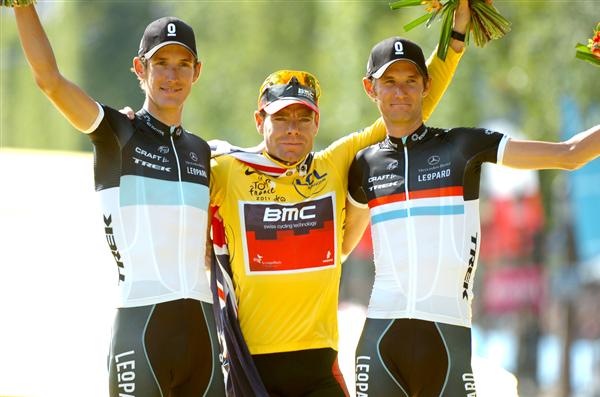
1. For obvious reasons, BMC’s Cadel Evans is the big winner of the Tour de France, winning his first grand tour and most important race since switching from mountain to road over a decade ago. Consistency and tenacity are two words that come to mind when attempting to describe the Aussie’s win—he also remained cool under pressure, a characteristic often lacking during his previous grand tour assaults. Some interesting facts about Evans’ victory:

  1. At 34 years of age, Evans is one of the oldest riders ever to win the Tour de France. While 34 isn’t “old” by and normal standard, it is for Tour winners.
  2. Evans spent all but one day inside the top-3 on GC.
  3. Since winning the 2009 World Championship Road Race, Evans has enjoyed the most successful two seasons of his career including wins at the Tour de France, Fleche-Wallone, Tirreno-Adriatico, the Tour of Romandie (for the second time), and stage victories at the Giro d’Italia and Tour de France. The “destructive” powers of the rainbow jersey are well-documented, but for Evans that wasn’t the case.

While it’s anyone’s guess where Evans will head from here program-wise, he can rest easy knowing that he’s finally gotten the monkey off his back.

2. Given his team’s expectations, Leopard Trek’s Frank Schleck might easily be categorized as one of the “losers” of the 2011 Tour de France. But after a race in which he was consistently one of the event’s strongest riders, a spot on the podium is an improvement—and an achievement that the elder brother has long-deserved. In fact, I wonder what Frank might have done had he not been saddled with the responsibility of looking out for Andy as there several days in which he looked to be the stronger of the two. Now, about that time trial…

3. For American teams not sponsored by Radio Shack, the 2011 Tour de France was a tremendous success. Overall, riders from American squads won 11 stages, the team classification, and the yellow and green jerseys. Sure, Americans themselves only won one individual stage thanks to Tyler Farrar’s Stage 3 victory, but that’s not really what it’s about now is it? As cycling becomes more globalized, it should be painfully obvious to teams looking up at the podium that maintaining the nationalized status quo simply isn’t the best recipe for winning races—and lots of them. The Tour success enjoyed by HTC-HighRoad, Garmin-Cervelo, and BMC (and while we’re at it, Team Sky) is less a testament to the superiority of one particular nation than it is for an entire philosophy of how to build a winning program.

4. While still largely a national squad, Belgium’s Omega Pharma-Lotto won three stages at the 2011 Tour de France, salvaging a successful race despite the loss of GC-contender Jurgen Van den Broeck. While Philippe Gilbert deserves credit for trying his best to make the Tour a one-man show, credit also goes to Andre Greipel for getting the better of Mark Cavendish on Stage 10, and Tour-revelation Jelle Vanendert for winning Stage 14 atop the Plateau de Beille and wearing the polka dot jersey for several days. So while the future homes of Gilbert and Omega Pharma remain to be seen, three wins and a Tour’s-worth of spotlight should help give everyone a soft landing (even if the same wasn’t true for VDBke).

5. I don’t know about you, but I’d happily trade 2 places on GC for a stage win and the polka dot jersey. Look for Euskaltel’s Samuel Sanchez at the front this weekend in San Sebastian.

6. Like the American teams already mentioned, Great Britain’s Team Sky has taken a globalized approach to building one of the top teams in the sport. And like Omega Pharma-Lotto, Sky persevered to enjoy a banner Tour despite the loss of its most expensive commodity and best GC-contender, Bradley Wiggins. In the end, the loss of Wiggo seems to have freed-up other riders to reach new heights, as evidenced by Edvald Boassen Hagen’s two stage wins, Gerraint Thomas’ gutsy breakaways, and Rigoberto Uran’s days spent in the white jersey as Best Young Rider. As these young stars continue to develop, they should couple with Bradley Wiggins to bring Team Sky even more Tour success in the future—especially if the rumors prove to be true about them having signed…

7. Mark Cavendish won another 5 stages at the 2011 Tour de France, bringing his career total to 20 and putting him on track to break Eddy Merckx’s record (34) by the time he turns 30. Even better for Boy Racer: he finally won the green jersey (even though it took a rule change and a miraculous chase on Stage 14 to get it for him).

8. After a lackluster spring that saw the World Champion wait until June before taking his first victory, Garmin-Cervelo’s Thor Hushovd certainly made up for lost time at the Tour de France, winning two stages (in the mountains, no less) and wearing the yellow jersey for 7 days. While it remains to be seen if the success will repair the rumored rift between the Norwegian and his team, it will certainly go a long way toward helping him—and his new asking-price—find a new one.

9. After a terrible 2010, many were wondering if Team Sky’s Edvald Boassen Hagen was more a product of the system at HTC-HighRoad than of his own talent. Those questions should be put to rest after EBH won two stages in fine style at the 2011 Tour de France. Winning via a bunch sprint and a breakaway, the young star looked on track to win the final ITT at one point too, before tired legs and a mechanical ruined his chances.

10. Norway had two riders in the 2011 Tour de France; they each won two stages and one spent 7 days in the yellow jersey. That’s a better winning percentage than even Charlie Sheen can boast.

11. Europcar was lucky just to exist heading into the 2011 season, but at the Tour de France they looked as if they were right where they belonged. Few were surprised to see Thomas Voeckler take the yellow jersey after Stage 9, but I think we were all a bit shocked to see him—and his more than able-bodied team—defend it for 10 stages (including all of the Pyrenees and more than half of the Alps). And even on the day in which it looked as if the team’s dream Tour was coming to an end, Pierre Rolland burst from a Voeckler-less lead group to take the win atop Alpe d’Huez, giving himself the white jersey to boot.

12. Young French GC contenders had a banner Tour de France, with Arnold Jeannesson of FDJ staking an early claim to the white jersey, Europcar’s Pierre Rolland winning it outright, and Saur’s Jerome Coppel finishing third in the competition. Cofidis fans might be quick to point-out Rein Taaramae’s second-place finish as well, but he’s Estonian—so that only half-counts. While it’s been said before with little to show for it, is it time to start taking Frenchmen seriously as Tour de France contenders?

13. Garmin-Cervelo riders used 4 different Cervélo framesets during the Tour: the P4, S5, R3, and R5ca. I’m not sure I can remember a time when that was the case. If cobbles return for 2012, maybe Specialized can equal the feat with their Tarmac, Venge, Roubaix, and Shiv?

14. Shimano won its first Tour de France since 2008, breaking SRAM’s two-year stranglehold. In addition, all three men on the final podium as well as both the green and polka dot jerseys rode the Japanese components. Perhaps more importantly, the 2011 Tour was the first grand tour win for the company’s electronic Di2 groupset.

15. And last but not least, Tahlia Chapman from Australia, you won our Velogames Fantasy TDF Cycling League. Send us an email so you can claim your prize!

As for you, who are your Winners from the 2011 Tour de France? Share them below—and come back tomorrow to see this year’s Losers.

Posted in Featured, Races | Tagged , , , , , , | 9 Comments