The Sticky Bidon – July 19, 2011

Fotoreporter Sirotti

Interesting cycling items from across the Internet, July 19, 2011

Seen any cool links we missed? Share ’em in the comments below!

Posted in Featured, Sticky Bidon | Tagged , , | Leave a comment

2011 Tour de France – Stage 16 Wrap-up

Pavé would like to thank Handspun, Clément, and Laekhouse for supporting our coverage of the 2011 Tour de France

Fotoreporter Sirotti

Today’s stage carried a lot of expectations and questions – would we finally see who the strongest GC contenders are? Would the Schlecks finally mount a meaningful attack? Would they decide who between them is the real leader? Would Alberto Contador falter or would he stage a coup? Could Cadel Evans and Ivan Basso once again demonstrate their strength and confidence? Is it up to Sammy Sanchez once again to take advantage of the negative racing, or is it up to Jelle Vanendert? Or, would it be the breakaway stage for a French winner? Despite the many opportunities afforded, the French have not won a single stage yet, and plenty of French teams and riders are more than willing to try again.

Here’s what we saw:

1. Lots of tired legs today, even after – or maybe because of – yesterday’s rest day. A large break was allowed to form early, and stayed out for the stage.

2. The race for white jersey for the Tour’s best young rider is starting to be defined. Sky gamely chased down a break containing FdJ’s Arnold Jeannesson in order to defend Rigoberto Uran’s hold on white.

3. Jeremy Roy’s at it again, after several brave tries already. Give this man a hearty chapeau!

4. Seeing Thor Hushovd ride so well and so aggressively while wearing the Rainbow Stripes brings tears to our eyes. Hushovd really serves his title righteously. Notably, he seems to have given up on Green aspirations and didn’t contest any of the intermediate sprints. Why bother contending if not to win, lest the leash be shortened for breakaways and potential stage wins? Numbers played to Garmin-Cervelo’s advantage once again, and to Hushovd and Ryder Hesjedal’s credit they played aggressively, and won. He’s indicated that he might be happier somewhere other than Garmin-Cervelo in 2012 – and he’s doing a hell of a job showing himself around.

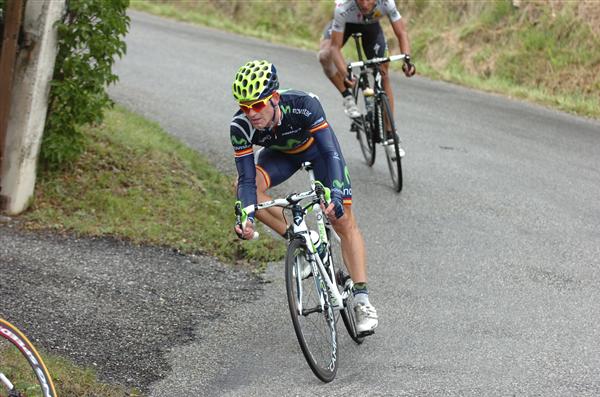
5. The race for GC has seen significant re-shuffling. Contador’s confident attack – squeezing on the tight inside of a switchback – was a complete surprise on what many thought was a sleepy day for GC contenders. A bigger surprise was the slow reaction from many GC contenders. Tommy Voeckler responded first, along with Cadel Evans and Sammy Sanchez. Voeckler paid for this effort, as did both Andy and Frank Schleck, who had faltered. In response, Evans and Sanchez were more than happy to help twist the knife and push the pace towards the finale, knowing that the descent favors a smaller group than a larger one. Gonzalez de Galdeano had warned that an angry Contador is not a good adversary to have to contend with. Today we saw that indeed this is true.

6. Cadel Evans finally rides like a man who believes in himself. His late attack that gapped Spaniards Sammy Sanchez and Alberto Contador was unthinkable to many a year ago. It didn’t amount to more than the few seconds he earned, but it must have been a tremendous boost in confidence.

7. Will Team Leopard-Trek re-think or finally decide their strategy? Frank is sitting at 1:49, just seconds off Cadel Evans, while Andy is at 3:03. Is Frank the leader starting from today?

8. Early on in the stage, many riders were attempting to sneak their way into the day’s breakaway, most notably Jose Joaquin Rojas, second place in the Points Classification, and Nicolas Roche, 18th on GC but with eyes for a top-10 finish. Rojas would have liked the intermediate points, but he still managed to scoop up a few remaining points at the finish, sprinting against Philippe Gilbert.

9. Among the North Americans, Ryder Hesjedal was the man of the stage, playing a great teammate to Hushovd’s strengths and controlling the break. The North American GC hope Tom Danielson came home a minute behind the first batch of GC contenders to maintain his top ten GC standing. Overall, a great day for Garmin-Cervelo.

10. The splitting of the GC standings suggests that there are two distinct sets of contenders. In the first, we have Voeckler, Evans, and F. Schleck all within a small time spread. In the second, we have A. Schleck, S. Sanchez, Contador, Basso, and Cunego. Does this suggest that the latter group are playing to defend their top-ten standings, while the former group are fighting for podium placings or outright victory? If so, the dynamics of the Alpine stages will be decidedly different from what we have seen so far, when more than a small handful of riders still had sights on the top rungs of of the General Classification.

11. The GC shortlist may require the addition of Tommy Voeckler. Names such as Sammy Sanchez, Juan Antonio Flecha, Bjarne Riis, and even Lance Armstrong have mentioned him as a true contender, and their pick for the overall this year.  The perception of him as a non-GC threat allowed him to gain some time in Stage 9, and he’s done an admirable job holding his own against the other top contenders.  Can he manage to hang on in the Alps?  Will the 1’45” lead he holds now over Cadel Evans be enough for him in the Stage 20 TT in Grenoble be enough?  Voeckler gives himself a 0% chance of winning, a comment repeated in publications spanning multiple languages, but what is the chance that he will ride the TT in yellow?  Do you rate his chances higher?  Let us know in the comments below.

Posted in Featured, Races | Tagged , , , , , , , , , | 6 Comments

The Sticky Bidon – July 18, 2011

Fotoreporter Sirotti

Interesting cycling items from across the Internet, July 18, 2011

Seen any cool links we missed? Share ’em in the comments below!

Posted in Featured, Sticky Bidon | Tagged , , , | Leave a comment

Rest Day Review: Easton EC90SL Components

Pavé would like to thank Handspun, Clément, and Laekhouse for supporting our coverage of the 2011 Tour de France.

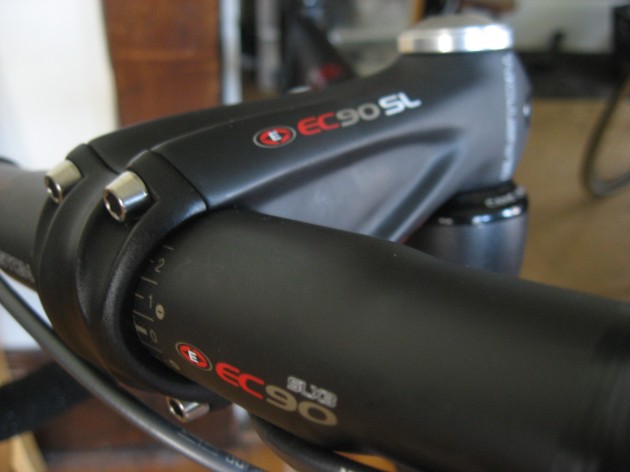
Photo by Matthew Montesano

Hot on the heels of Jeremy’s post on modern carbon componentry, we’d like to share with you our experience riding some state-of-the-art carbon bits and pieces: an Easton EC90SL stem, EC90SLX3 handlebars, and EC90 seatpost. Now, I admit that I am a late adopter. Until just last year I was still riding 9 speed; I admitted that I had not yet rolled wide rims in our review of Handspun-built HED C2 Belgiums. In addition, there are some parts I don’t justify spending much money on. I prefer to rummage in used bins for $20 handlebars and stems. If a bar is a classic bend, that’s great. If a stem isn’t ugly and doesn’t weigh more than my cranks, that’s a bonus. That’s about as advanced as I’ve got.

This means that I’ve ignored some of the advancements in the industry, and when I opened a box containing an EC90SL stem and EC90SLX3 handlebars, I was shocked. The handlebars – oversized at the clamp, with a compact, variable-radius bend (more on that later) – weigh in at just over 200g, and the stem, just over 100g. My new cockpit therefor weighs well under a pound: much, much less than my older setup. And sure, weight is only a concern for those going up mountain passes with an eye on a stopwatch and a powermeter, or for those seeking to build a particularly light bike for fun and the jealousy of their riding buddies (don’t lie!). While I’m impressed with the weight of these parts, it’s not a huge concern to me. Much more interesting to me is the shape of the handlebars, and the stiffness of the stem/handlebar interface.

The variable-radius bend – a feature of many modern “compact” handlebars – is made for integrated shifting and the subtle but important changes that “on the hoods” riding makes to a rider’s fit. When I mounted the stem and bars, my hoods (Campagnolo, 2nd generation shape) were higher and closer. When riding in the drops, I had two very comfortable positions to choose from: back in the drops, a comfortable cruising position, and forward in the drops, for sprinting. Handlebars with this bend can be quite comfortable, but more importantly, they’re an interesting way to tweak your fit. A compact handlebar is a crucial tool to consider for getting maximum comfort and use from your bike, and they can have several different effects – you can use them to attain a higher, even transition from bars to hoods, or you can also use them to get some more comfort from a low handlebar setup.

Easton touts some intelligent carbon design for these handlebars that results in a careful combination of stiffness and flexibility, and it’s noticeable. When my hands were “back” in the drops – in a low crusing position, rather than a forward, fingertips-at-the-levers position – there’s some obvious flex built into the system. I could grab the drops and twist and flex them. I appreciated the additional comfort this led to my ride – I ride a very stiff bike (a Spooky Skeletor), and the effect of these bars was similar to riding a high-quality carbon fork. One might not notice the difference between two high-quality carbon forks, but if you move from a low-end to a high-end one (as I had with an unbadged cheap-o to an Alpha Q and then an Easton EA90SL fork, incidentally – though separate from receiving these parts for a Pavé review), you feel the effect. And, similarly, I felt the effect of going from old alumiinum handlebars to high-quality, modern carbon bars.

The final evident quality of this setup is its stiffness. Bear with me as I follow a paragraph on flex and comfort with one on stiffness, but I was fairly intrigued at this characteristic of these parts. Back in the drops, they flex. Forward in the drops – by the tighter radius of the bend – you get the full effect of the carbon’s ability to be specifically woven for varying strength. I suppose I’ve never ridden a very stiff stem & bar, and in fact had poo-poo’ed discussion of them as snake oil aimed at getting people to spend money. Sure – until I climbed and sprinted on them. Then, I felt that elusive feeling that stiff parts offer – the sense that you can put a bit more into your bike. Sprinting and climbing may be mainly about the legs, but many will tell you that some upper-body and core workouts can improve one’s performance and power output. It stands to reason that a stiff cockpit helps.

I also test-rode Easton’s EC90 seatpost. On first glance, it’s evident that the saddle clamp is fairly bulky, and as with almost all seatposts, it lacks the ability to adjust tilt and fore/aft saddle position independently of each other. However, like the other Easton carbon components, it’s impressively light, with some flex built into to the system providing some additional comfort to the bike’s system.

The sixty-four thousand dollar question, of course, is how much is one willing to spend for all these benefits? The Easton cockpit is not cheap, with the handlebars and stem each retailing for well over $200. They may not be as expensive as other parts out there, and indeed, considering the direction of bike parts’ prices (as well as quality and performance), it’s neither unusual nor unrealistic for many consumers. So, for those willing to drop the coin on high-quality bits,, the Easton EC90 SL and SLX3 stem/bar combination, and the EC90 seatpost are very fine choices indeed.

My own reaction is a bit more modest. Riding these parts was a delightful experience indeed, but my cycling takes place on a budget. They haven’t convinced me to spend $200 bucks on a stem or handlebar – however, they have convinced me of the importance and value of some of the advancements in handlebars and stems that have been made in the past ten or fifteen years. I can be riding lighter and stiffer parts, and not feel as though I’m throwing money down the drain. I think it’s time to open up my budget just a bit more.

Posted in Equipment, Featured | Tagged , , | 5 Comments

Pro Tech: Carbon Componentry

Photo courtesy of Easton

If you’re anything like us, you’re taking the opportunity (with today’s rest day in the Tour de France) to catch up on pretty pictures of pro bikes and the emerging technology that sponsors roll out to their teams for the Tour de France. To complement this, we’ll be publishing a rest day review of some carbon fiber componentry later today, so we figured we’d take a quick opportunity to give some background information on the construction methods commonly employed in construction.

In the last 20 years, carbon frames in the pro peloton has gone from an option for well funded teams in the mountains, to the de facto year-round choice. While the occasional aluminum frame may show up under certain riders during the spring classics, most pro teams outfit their riders exclusively with carbon.

That said, while carbon frames have entirely supplanted steel and aluminum in the pro ranks, teams have been slower to adopt composite componentry, particularly in the cockpit, opting to use aluminum bars and stem. Reasons cited include carbon components being too flexible, too stiff, subject to extreme failure modes, and just not made to last – a myriad of criticisms that apply perhaps to some, but not all, carbon components. The last few years, however, have seen a number of teams switch over to carbon components without the predicted failures.

A number of the upsides to carbon in frames also applies to componentry. Carbon bars and stems can be crafted in any shape imagined, allowing them to be more aerodynamic than a comparable aluminum component, while maintaining their feather weight. The carbon layup can be optimized to provide stiffness where appropriate, or a little bit of give to improve comfort. With the diminishing costs of carbon components, some of the concerns about replacing components after a crash fade away – a crash that would destroy or put a carbon bar in to question would likely do the same to an aluminum one. Much like carbon frames earned an initially poor reputation based on the earliest attempts at building them, carbon components have suffered due to a lack of carbon-specific engineering put forth in the earliest days. If you design a carbon frame, stem, bar, wheel or seat post as if they’re made from a traditional material, they’ll perform poorly. Take advantage of the specific characteristics of carbon, however, and you can build items that are light, strong, and not so bank-breaking so as to require a 2nd mortgage on your house.

Construction Methods

Carbon components are usually constructed via one of two techniques, though modern component design can blur the two together.

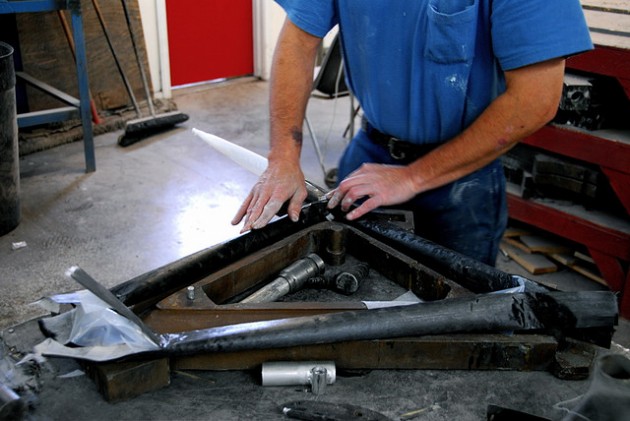
The first method is similar to the tube-to-tube construction method employed by some frame manufacturers, particularly in the early days of carbon frames. In this method, carbon fiber tubes are joined to aluminum castings. For a stem, this would allow the extension to be created from a carbon tube, with the steerer and bar clamping sections made out of aluminum. It’s a simple construction method in that it allows the use of aluminum in high stress, threaded portions – eliminating slippage of bars or fork, and reduces the likelihood of stripping a bolt hole. The weight savings, however, are somewhat limited, and the options in shape for the extension portion can cause some of the flexibility used as a criticism.

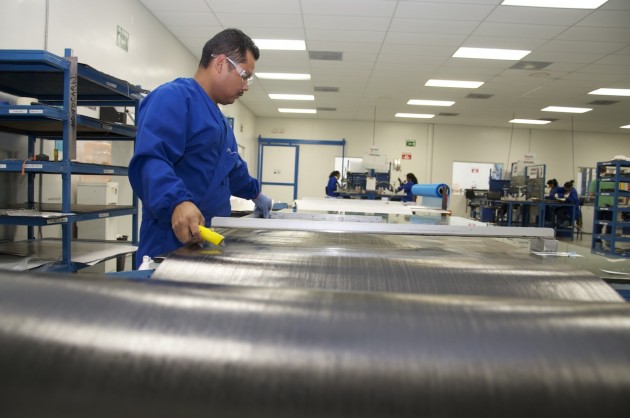
The other is a method employed by most modern frame manufacturers in the building of monocoque frames, and involves using carbon fiber sheets that are pre-impregnated with temperature sensitive resin (often called pre-preg carbon fiber). These sheets are placed in a specific layup pattern in a 2-piece mold, with an inflatable bladder, foam, or other materials where the hollow voids will ultimately be. The mold is clamped together, the bladder inflated to a high enough pressure to push the carbon sheets in to the crevices of the mold, and the whole thing is baked at the temperature required to cause the resin to set. For stems, this method requires unique molds for every length and angle available, but does allow for a huge amount of flexibility in the design. By adding pieces of carbon fiber in specific locations, areas that are subject to higher stresses can be reinforced. Some manufacturers utilize aluminum inserts, either to provide a little extra strength, introduce aluminum in to areas likely to have slipping issues, or to introduce threaded inserts, thus reducing the likelihood of stripage. While these stems are often on the lighter side, some riders have issues with bars slipping, due to lower friction and limits on how highly bolts should be torqued. The use of carbon prep pastes, which contain small beads or other corse material, usually addresses these issues.

Both tube-to-tube and mold-and-bladder construction methods can turn out a stem that is both strong and light, if proper engineering is performed, and they are assembled in a controlled environment. The resins used in tube-to-tube construction are temperature and contaminant sensitive. When combined with aluminum inserts, care must be taken to ensure suitable fit that allows the correct amount of resin to exist between the pieces, while not leaving voids. In addition, the potential for galvanic corrosion between bare aluminum and carbon dictates that some sort of barrier be placed between them – this can be a single layer of fiberglass to insulate carbon from aluminum, or in some cases anodization or a surface prep specifically designed to reduce the likelihood of a reaction. Much like liquid resin, pre-preg sheets are temperature sensitive, as exposure to temperature variation can cause partial hardening of the impregnated resin. A failure to allow sufficient baking time can result in not all resin properly curing. Insufficient bladder pressure, or bladders that aren’t properly tailored to the stem shape can result in insufficient compaction, resulting in voids that compromise the strength of the stem. Finally, the lack of a well designed layup schedule (the “recipe” that determines the shape, alignment and order of carbon fiber fabric used in construction) can result in a compomemt that is lacking in rigidity and strength when subject to the stresses the component is likely to see.

In the proper hands, however, carbon allows for components that are strong, stiff, designed to cheat the wind or conform to the body in ways that cannot be economically achieved in other materials, and do so in a svelte, lightweight manner.

Coming soon: a review of carbon components.

Posted in Equipment, Featured | Tagged , | 1 Comment

2011 Tour de France – Stage 15 Wrap-Up/Discuss

Pavé would like to thank Handspun, Clément, and Laekhouse for supporting our coverage of the 2011 Tour de France

Fotoreporter Sirotti

There’s really not much to say about today’s Stage 15 of the 2011 Tour de France other than what else can you say about Mark Cavendish and Team HTC-HighRoad? With Cav’s fourth stage win of the race, the Manxman now has a solid grasp on the green jersey competition. So here’s my question for your Sunday:

With stages on Tuesday and Wednesday that suit his talents, does Belgium’s Philippe Gilbert still have a shot at becoming the first rider since Sean Kelly in 1989 to win both Liege-Bastogne-Liege and the Tour’s green jersey in the same year?

Share your thoughts and comments below.

Posted in Featured, Races, Teams | Tagged , , , , , , | 7 Comments